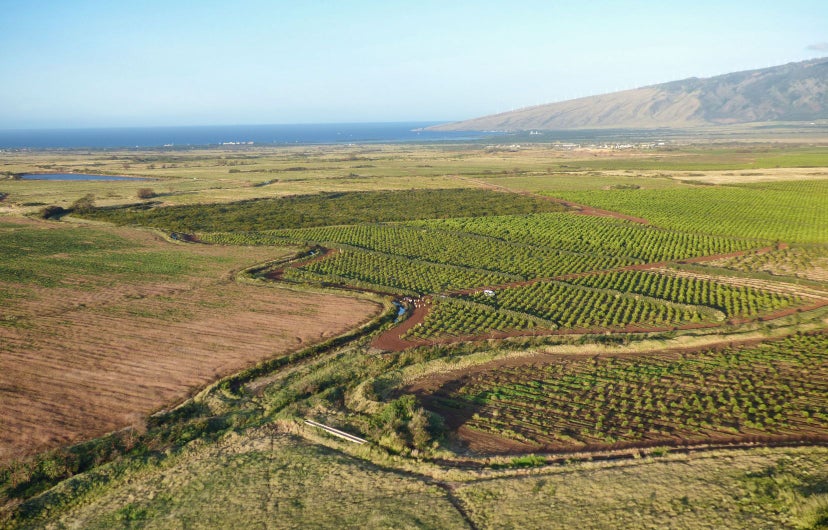
 Aerial view of Mahi Pono fields in the central valley of the Hawaiian island of Maui in 2024. Photo: Citrus sp. Creative Commons Flickr.Le Devoir | 29 July 2025
PSP Investments becomes sole owner of controversial irrigation system in Hawaii
by Alexis Riopel
(Note: translated from the original in French by GRAIN.)
A Canadian pension fund has just taken sole control of Hawaii's largest irrigation system and pocketed $75 million at the expense of its former owner, a sugar plantation, while a standoff with a new public water management agency looms.
PSP Investments, a federal Crown corporation responsible for the pension plan of Canadian public servants, became the sole owner of East Maui Irrigation (EMI) in mid-June through its agricultural company Mahi Pono, founded in Hawaii in 2018 and based on the island of Maui.
The EMI irrigation network, created in 1876, consists of dozens of kilometres of pipes. It diverts streams flowing down the rainy side of a volcano. For a century and a half, this titanic structure irrigated the sugar cane crops of Alexander & Baldwin (A&B), an economic and political heavyweight in Hawaii. However, the sugar industry eventually collapsed. In 2018, A&B sold its vast, fallow estate to PSP for US$267 million.
The pension fund, headquartered in Montreal, then founded Mahi Pono (‘virtuous farm’) and invested heavily to revive the land, where citrus fruits are mainly grown.
Through the same transaction, Mahi Pono also became the 50% owner of EMI. The irrigation network is essential for crops grown on this arid 16,500-hectare estate, which covers nearly one-tenth of the island of Maui. A&B, which now focuses its business on real estate, remains the owner of the other 50% of the water network. The sales contract stipulates that both partners will endeavour to acquire a long-term lease to continue drawing water from public lands for at least 30 years. If this lease is not obtained from the Hawaiian government by the end of 2026, A&B must pay US$62 million in compensation to Mahi Pono.
Since the 1980s, EMI has been granted annual permits by the Water Resources Management Commission, which is part of the Hawaii Department of Land and Natural Resources, to use water from public lands. Mahi Pono would prefer to sign a long-term agreement to secure its operations.
Seven years after the purchase, the long-term lease has still not been secured. And now, 18 months before the deadline, A&B and Mahi Pono are ending their partnership. On June 17, the former plantation sold its half of EMI to Mahi Pono. It will pay US$55 million over four years to the firm owned by the Canadian civil service pension plan — a discount compared to the terms of the contract.
As an explanation, A&B says it wants to focus on its core business, commercial real estate. ‘Given their divergent missions, the parties have agreed to go their separate ways,’ said Mahi Pono's vice president of operations, Grant Nakama, in a statement released to the media.
EMI has been the subject of litigation for decades. Environmentalists and traditional farmers believe that the irrigation system, now in poor condition, draws too much water from the mountain, damaging ecosystems and indigenous practices. These tensions are also exacerbated by the increasingly frequent droughts in Hawaii.
‘In my opinion, PSP Investments no longer believed that A&B would be able to help it obtain the long-term lease,’ observed Shay Chan Hodges, a Haʻikū resident who has been following the case for years, during a videoconference interview with Le Devoir. ‘Clearly, it's not the slam dunk they imagined in 2018...’ adds the former member of a citizen water committee.
A new entity
A major development in 2022 complicates EMI's task of obtaining a 30-year government licence: the creation by referendum of the East Maui Water Authority.
This new entity, widely supported by the population, has a mandate to take control of the irrigation system. ‘A people must control their water to control their destiny,’ Jonathan Likeke Scheuer, chairman of the board of directors of the East Maui Water Authority, whose work began in February 2024, told Le Devoir.
In Mr. Scheuer's view, it is unacceptable for a foreign company to be in charge of the irrigation system. ‘This situation is undemocratic and perpetuates the old plantation-era idea that the people of Hawaii are incapable of taking charge of their own affairs,’ said Scheuer, who represents the Hawaiian Homes Commission on the new board.
The East Maui Water Authority's board of directors is made up of 11 members, including eight growers of taro, a traditional Hawaiian food. The organisation, which is part of Maui County, has a director and a small technical team. If it secures a long-term lease, Mahi Pono will become its customer for water supplies.
‘No one on the Authority's board wants Mahi Pono to fail,’ Scheuer emphasises. However, the organisation would impose certain limits. Its priority is to manage water in a way that improves the health of ecosystems and local communities at a time when Hawaii's streams are drying up like never before.
Is Mahi Pono still seeking a long-term lease from the Hawaiian government? When contacted by Le Devoir, Mahi Pono and PSP did not respond explicitly to the question.
‘Agriculture in Hawaii needs an adequate and reliable water supply, and Mahi Pono is continuing its efforts to reach an agreement that balances agricultural needs with responsible resource management,’ the company replied by email. ‘As the sole owner of EMI, Mahi Pono will continue to implement best practices in water efficiency and sustainable agriculture,’ it added.
According to Mr. Scheuer, private discussions between the East Maui Water Authority and Mahi Pono ‘are going well.’ However, he points out that PSP Investments, the real decision-maker in this case, manages $300 billion in assets worldwide. ‘It's a bit like David versus Goliath,’ he said.
No one knows when the Water Management Commission will convene hearings to award a long-term lease for the management of East Maui's water. A quasi-judicial process — involving lawyers, expert testimony and pleadings — will then get underway.
Jonathan Likeke Scheuer intends to be ready. ‘For a century and a half, most of the big decisions about East Maui water were made in Honolulu. Now they're being made in Canada,’ he laments. ‘We're not saying that this company [Mahi Pono] shouldn't receive water, but we don't want it to own the irrigation system. We want to own it. And we want to manage the system so that everyone can benefit from it.’