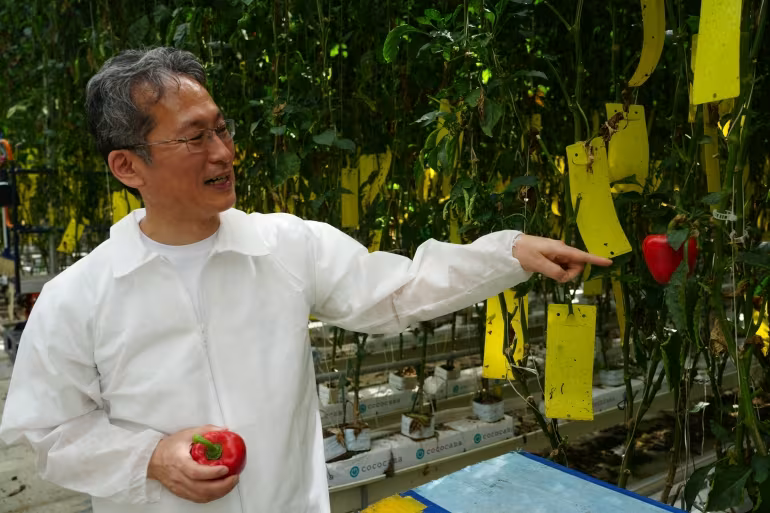
 Kazunori Hisaeda, president of Daiwa Food & Agriculture. (Photo by Haruki Kitagawa)Nikkei | 18 August 2025
Daiwa Securities eyes turning pepper farms into financial products
by HARUKI KITAGAWA
TOKYO -- Money is creating a sea change in Japan's agricultural sector, but the waves are not coming from retail giants such as Aeon, Seven & i Holdings, or the Japan Agricultural Cooperatives Group. Instead, Daiwa Securities Group is disrupting the market with its ambition to become king of bell peppers.
In Iwata city in Shizuoka prefecture, south of Tokyo, sits a cluster of translucent buildings spanning three hectares, or about four soccer fields. The site houses 80,000 pepper plants, producing roughly 430 metric tonnes per year. Workers donning helmets use specialized machines to harvest red and yellow bell peppers from plants that reach almost to the ceiling.
After expanding its growing area through acquisitions, Daiwa holds a roughly 20% share of pepper sales in Japan, a stone's throw away from the market leader. While it is not unusual for companies to enter the field, Daiwa stands apart due to its goal: turning pepper farms into a financial product.
"We'll use the power of investment money to change Japanese agriculture," said Kazunori Hisaeda, president of Daiwa Food & Agriculture, which operates the Iwata farm.
While Japan's consumption of peppers is increasing, domestic production remains low. Daiwa aims to attract money from investors to update equipment and expand the scale of its growing operations, then return profits from its pepper sales to investors. It also plans to launch a dedicated fund, using money to transform Japan's notoriously inefficient agriculture industry.
The goal of investment is to use money to create new money. Whether in stocks, bonds, or real estate, investments cannot make a profit unless they successfully compete, and efficiency is essential. When businesses compete, some fail and the survivors naturally get larger. The focus on profit gives rise to innovation that can help expand food production to meet global demand.
A money-losing farm acquired by Daiwa became profitable in 2022 within a year through steps such as making its farming methods more efficient and reviewing transportation costs. Prices for its products were up nearly 20%. Daiwa's goal is to boost productivity and draw investor money specifically to peppers from among the many vegetables out there.
Global food consumption is rising 1.2% annually amid population growth in emerging economies, according to the Organization for Economic Cooperation and Development and the U.N. Food and Agriculture Organization. Agricultural output is growing just 1%, which raises the possibility that it may eventually be unable to keep up with demand.
Tricky problems often present good chances to make money. According to an estimate by Canadian insurer Manulife Group, a leading global asset manager, there are $2 trillion in investment opportunities in dealing with the gap between food demand and production.
Manulife also invests funds from financial institutions and other players in nut and fruit farms. It is one of the world's top producers of almonds, among other crops. It has adopted more-efficient farming methods on about half its land that reduce the amount of tilling needed, a measure that has cut growing costs by about 20% on its own.
Elsewhere, U.S. asset manager Nuveen owns a vineyard in California's Napa Valley. Nuveen has over $13 billion in land-based assets in its portfolio. In Australia, the investment banker Macquarie Group extends capital to major beef and cotton companies.
Globally, agricultural-focused funds reached $62.7 billion last year, according to data from Preqin, a British financial analytics firm. The balance is nearly triple from a decade earlier.
"Investment leads to technological innovation and improved productivity," said Kouki Takayama, senior economist at the Norinchukin Research Institute. "With the number of farmers in Japan declining, investment to improve efficiency will be necessary."
alt
However, investments in Japan's agriculture, forestry and fisheries industries have plunged 40% over two decades to $10.4 billion in 2023, according to FAO data. Worldwide, such investments had more than doubled over the same period.
Japan is the only Group of Seven country to experience a decrease. International investment funds are reluctant to invest in Japanese farmland due to the plethora of regulations regarding sales, purchases and leasing of the properties. Japan is not included in Manulife's $2 trillion investment opportunity estimate.
Symbolizing this decline, Japan fell from the third-biggest rice producer in 1969 to 15th place today, according to a survey by Katsumi Arahata, professor at Japan International University. Japan's longstanding rice control policy contributed to that trend.