 BVK Nachhaltigkeitsbericht | 2024
 (Below is a Deepl translation of the original German text)
The BVK is committed 2024: Human rights are not arbitrarily expandable
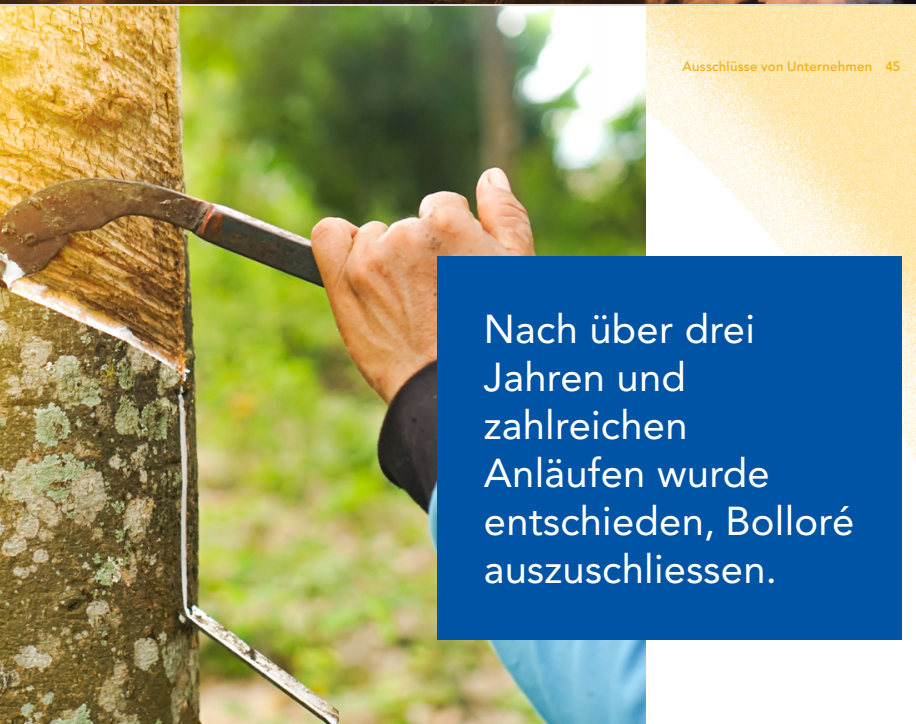
After more than three years and numerous attempts, it was decided to exclude Bolloré.
Rubber is a funny word in itself, with a long history behind it. The current story of rubber is less funny, however, as it involves human rights violations and exploitation. The BVK responded with the last possible measure: exclusion!
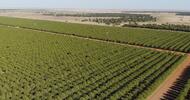
Rubber seals, car tyres, rubber bands to hold things together, erasers for pencils – our everyday lives would be much less flexible without this versatile material, which is obtained as latex from special trees and turned into rubber through vulcanisation. Rubber can now also be produced synthetically. According to Statista, total production in 2023 amounted to 28.8 million tonnes. About 40 per cent of this is natural rubber.
Invented long before Columbus
Rubber was invented by the indigenous peoples of South America. They had already found ways to dry the latex extracted from trees into rubber and process it into rubber using a special smoking process. The oldest known objects made of rubber date back to around 1600 BC. In 1839, Charles Goodyear, inspired by Friedrich Wilhelm Lüdersdorff, invented hard rubber using vulcanisation, which triggered a real rubber boom. Incidentally, Goodyear, now the third-largest tyre manufacturer, was only founded in 1898 by the Seiberling brothers, who named their company after the inventor of vulcanisation.
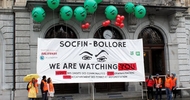
Even today, natural rubber is still collected and traded in large quantities. Among others, by the French conglomerate Bolloré, which is active in a wide range of business areas, including logistics, energy, advertising, publishing and TV (Canal+). The company, controlled by the Bolloré family, is also one of the main shareholders in the Luxembourg-based Socfin Group, which operates rubber and palm oil plantations in Central and West Africa and Southeast Asia.
Displacement and violence
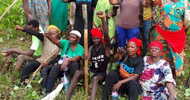
For over a decade, Socfin, which is also based in Switzerland, has been accused of serious human rights violations. The allegations are that the plantations in Liberia, Sierra Leone, Nigeria, Cameroon and Cambodia systematically violate the land rights of the local population. Entire villages have had to make way for the plantations, and some of the rightful owners have been forcibly evicted. Life on the plantations is also marked by violence and sexual harassment. An investigation commissioned by Socfin even confirmed most of these allegations.
Bolloré bears responsibility
The OECD Guidelines, which Switzerland also supports, oblige multinational companies to protect human rights within their sphere of influence. Despite the clarity of this internationally recognised standard, Bolloré does not consider itself obliged to comply with regard to Socfin. Since 2010, there have been repeated complaints to the OECD contact points, which mediate in disputes. But so far without success. An action plan agreed in 2013 was declared unenforceable in 2014. A lawsuit before a French court seeking to enforce its implementation is pending.
Dialogue aims at prevention
The Swiss Association for Responsible Investment (SVVK), of which BVK is a founding member, identified a possible violation of its normative principles by Bolloré during its periodic portfolio screening. In 2020, the association sought an engagement dialogue with those responsible. The aim was not to judge what had happened, but to prevent similar cases in the future. Specifically, it demanded that Bolloré insist on the implementation of human rights guidelines within its sphere of influence. In particular, the company should require Socfin to obtain the consent of the affected population for its plantation projects. However, as in the OECD mediation process, Bolloré insisted on its position: as a minority shareholder in Socfin, it could not take action.
Weak argument
This argument is unconvincing. The OECD Guidelines require companies to protect human rights beyond their corporate boundaries within their sphere of influence. Bolloré's influence within the meaning of these guidelines is considered to be very high, as the Bolloré Group holds almost 40 per cent of Socfin, while 55 per cent is owned by a former Bolloré board member and close confidant of the Bolloré founder. Together with three sons, they still form the Socfin board today.
Exclusion as a last resort
Despite numerous attempts over more than three years, Bolloré has shown no willingness to address its influence. Bolloré maintains that its responsibility ends at the corporate boundary.
As a result, in June 2023, the SVVK recommended that its members sell their holdings in Bolloré and refrain from investing until further notice. The BVK followed this recommendation and excluded Bolloré from its investment universe.