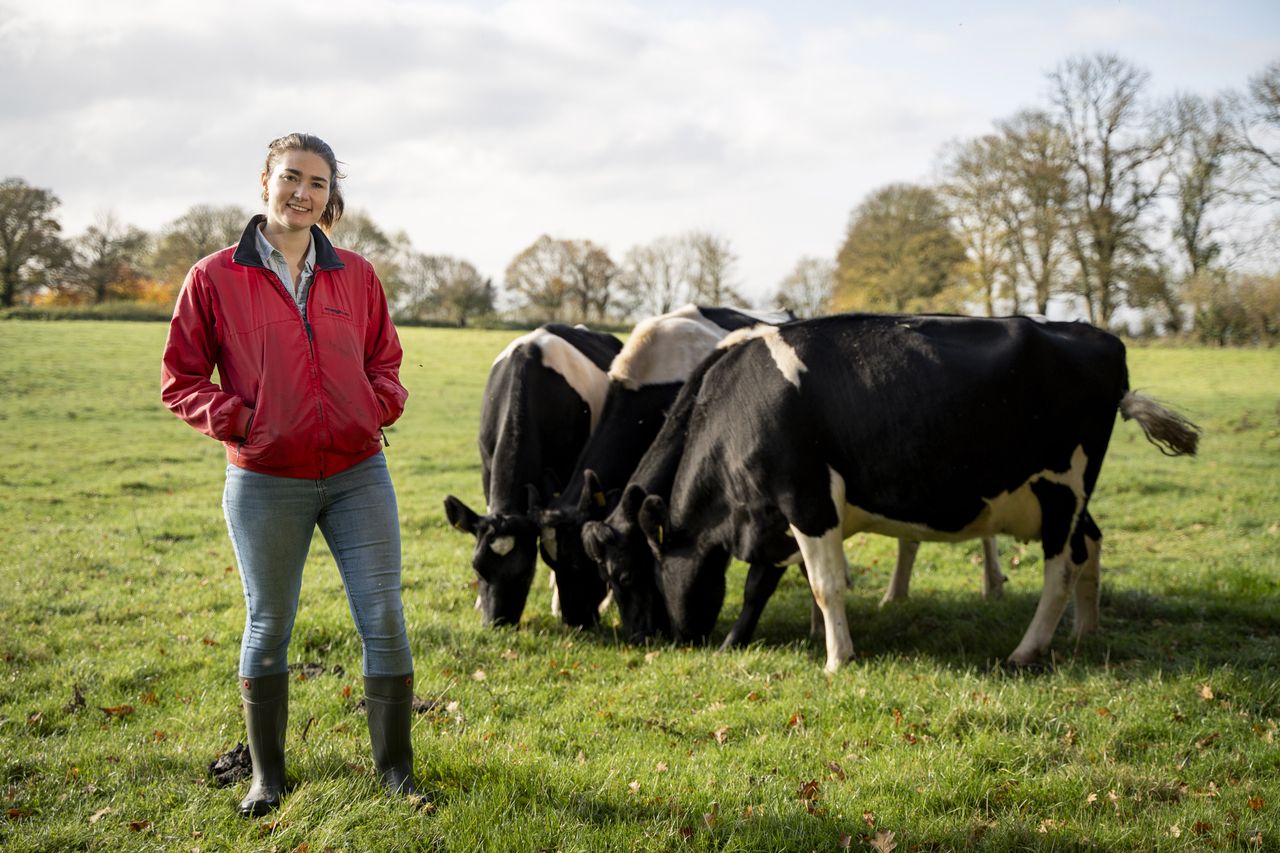
 Hannah Quinn-Mulligan on her Co Limerick farm. Photos: Don MoloneyIrish Independent | 7 April 2026
Land grab of quasi-farmers and business investors has to be stopped
by Hannah Quinn-Mulligan
How is a farmer meant to outbid an investor for land in today’s market? Even more pressing is how is a qualifying young farmer under 35 meant to outbid an investor for land in order to make use of the stamp duty relief?
If the average age of a first-time buyer has hit 42, then how is someone meant to afford a farm when they’re under 35?
It’s these thoughts that have been rattling around my head since I’ve simultaneously tipped the ageing scales over 35 and tipped the income scales to cautiously consider that I could expand the home farm acreage.
However, every land parcel around me is averaging €18,000/ac and given my proximity to Limerick city, I have about as much chance as a snowball in hell of managing to outbid some local developer.
For example, if I bought land worth €100,000 then I’m facing another 7.5pc stamp duty or €7,500 on top of that plus whatever solicitor’s bill comes on top of that. All this for a proven active farmer with their agricultural qualifications, who is going to farm the land productively to produce food.
If it’s not developers outbidding farmers, it seems to be a type of quasi-farmer with deep pockets from a lifetime in business who now wants to farm anything from a handful of sucklers to guinea pigs, or who wants to rewild some lovely patch of land that at the very least would make a cracking traditional hay meadow rather than a briar patch.
Don’t get me wrong, I love trees, overgrown hedges and have plenty of briar patches but I’m also serving local food, directly from the farm, to at least 100 people every week and all the recent talk about a spike in food prices has got me thinking about food security.
'I don’t think relying on chemical fertiliser and imported feed is the best model for sustainable agriculture, but neither do I think it’s a good idea to rewild every inch of productive farmland'
To be blunt, I don’t think relying on chemical fertiliser and imported feed is the best model for sustainable agriculture, but neither do I think it’s a good idea to rewild every inch of productive farmland. If you want local food then you need local farmers to actually grow it.
If you look at other countries, there are a number of measures in place to ensure that local farmers get first preference for local land.
France: There is a SAFER system that monitors farmland sales, can intervene in transactions, has a pre-emptive right to buy land, can propose a different buyer or price, and is explicitly used to support farmer installation, especially young farmers, as well as consolidation and transparency in the rural land market.
In practice, that means the market is not left entirely to the highest bidder.
Germany: Farmland purchases are generally subject to approval by the agricultural authority under the land transaction regime. The stated purpose is to improve the agricultural structure, and transfers can be blocked where they would undermine that structure.
Germany is less interventionist than France, but it still treats farmland as a strategic asset rather than an ordinary commodity.
Denmark: Denmark has historically used a more farmer-centred access model. For many agricultural properties over 30ha, the buyer must take up permanent residence, operate the property and meet agricultural education requirements; there are also ownership and distance limits in the same law.
Outside the ordinary rule-set, acquisition may require ministerial permission. Denmark also has wider rules under which foreign nationals generally need residence or prior residence to buy property, though EU/EEA nationals and companies have carve-outs in some circumstances.
I particularly like the Danish approach. Imagine if those kinds of rules had been in place here? There would be no faceless pension funds with vast swathes of Sitka spruce forestry in counties like Leitrim. If farmers have to be subjected to a 30km distance rule between land holdings when it comes to the nitrates derogation, then why isn’t there a distance rule for the buyer of farmland?
Only about 0.5pc of land comes up for sale nationally every year and it’s estimated up to a quarter of this is bought by non-farmers. Even if they don’t get the land, they are turning up at auctions and pushing prices well beyond the realms of most farmers.
Why would you not put measures in place to ensure that young farmers and local farmers got first preference and keep farming alive and in the hands of local farm families?
The first action should be to raise the stamp duty relief for young farmers to 40 when purchasing land as opposed to being gifted it. In the technical CAP definition of a young farmer, the age limit is already under 40, and I promise to personally put any increase in the age limit on stamp duty to good use.
Hannah Quinn-Mulligan is a journalist and an organic beef and dairy farmer