 AgroLatam | 19 July 2026
Foreign farmland crackdown sparks new fears across US agriculture
by Marco Díaz Collins
Foreign ownership of U.S. agricultural land is facing unprecedented political and regulatory scrutiny in 2026, as states and federal authorities push new restrictions that could significantly alter farmland transactions, reporting obligations, and investment strategies. The debate intensified after several states adopted new laws and the U.S. Department of Agriculture proposed a major overhaul of the Agricultural Foreign Investment Disclosure Act (AFIDA). The issue matters because changes in ownership rules could influence land values, investment flows, due diligence costs, and long-term competitiveness across the American farm sector.
According to Harrison Pittman, director of the National Agricultural Law Center, the current wave of legislative activity began accelerating in 2021 and has continued to gain momentum. Approximately 46 million acres of U.S. agricultural land-about 3.6% of privately held farmland-are currently under some form of foreign ownership, according to AFIDA data. While that percentage remains relatively small compared to total U.S. farmland, policymakers increasingly view agricultural land as a strategic national asset tied to food security, supply chains, and geopolitical competition.
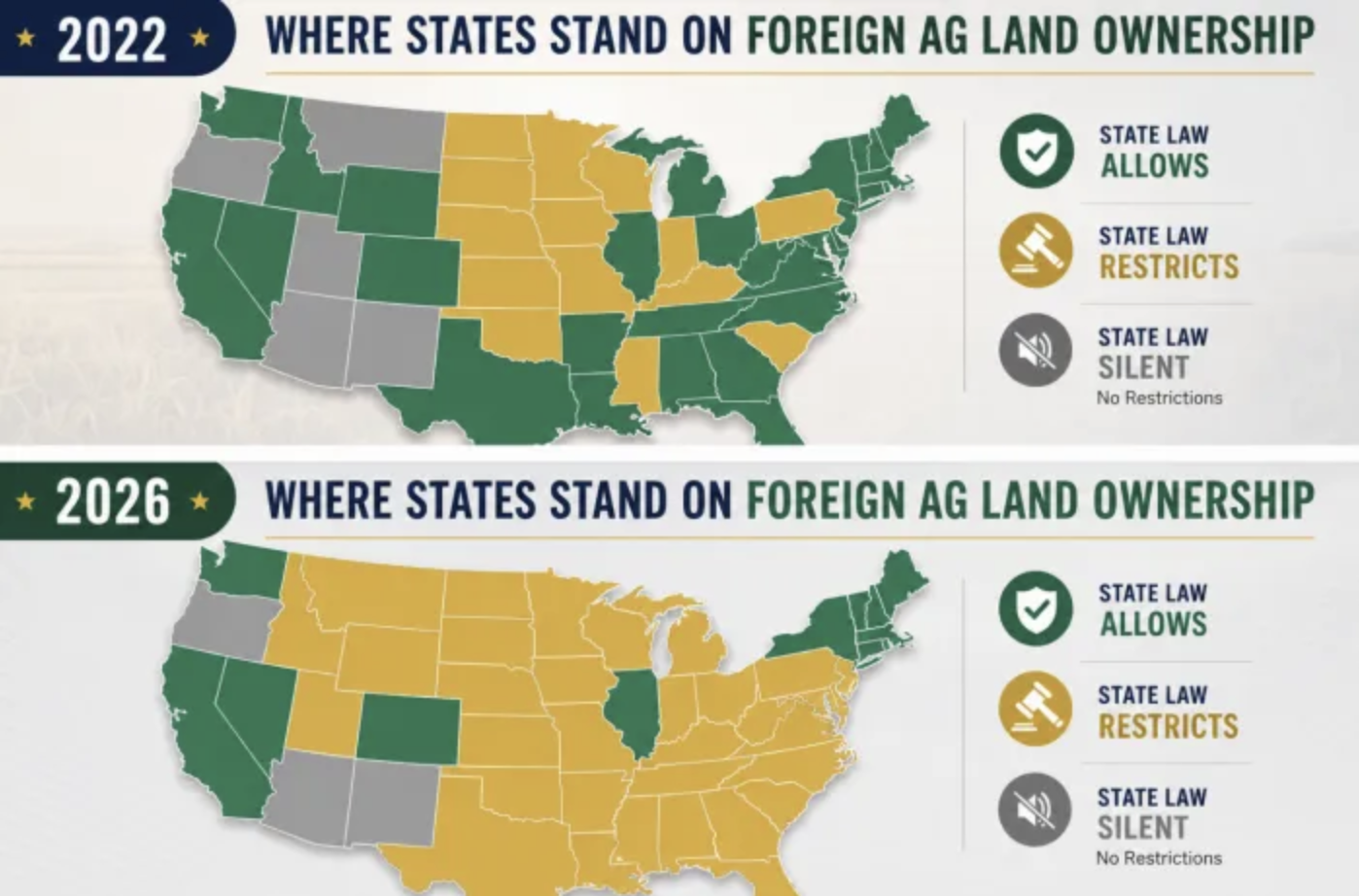
The most immediate changes are occurring at the state level. Legislative activity expanded sharply beginning in 2023, when more than half of U.S. states introduced proposals related to foreign ownership of agricultural land. Fifteen states enacted new restrictions and several others amended existing statutes. The trend has persisted into 2025 and 2026, signaling that farmland transactions will likely face growing scrutiny for years ahead.
A significant shift in policy design has also emerged. Instead of broadly restricting investors from all foreign nations, many states are now targeting entities linked to "foreign adversaries" or "countries of concern." This narrower approach has made legislation politically easier to advance while increasing compliance complexity for buyers, investors, and agricultural businesses. For producers and landowners, this means that ownership structures, investor relationships, and corporate affiliations may become increasingly important during transactions.
USDA's Proposed AFIDA Rewrite Could Change Compliance Rules
At the federal level, USDA is considering what could become the most significant administrative revision of AFIDA since the law was enacted in 1978. The proposal would move oversight responsibilities into USDA's Office of Homeland Security and replace the current regulatory framework with an entirely new structure.
The proposed changes could modernize reporting requirements but also substantially increase compliance burdens. Expanded definitions, additional disclosure obligations, and revised penalty and appeals procedures may require landowners and investors to conduct deeper investigations into ownership arrangements and beneficial interests.
Legal experts warn that several key definitions remain unclear, including terms such as "beneficial owner," "acting in concert," and "foreign adversary-controlled entity." The interpretation of these concepts could determine whether certain transactions receive regulatory approval or face additional review.
Although public debate frequently focuses on China, available data indicate that Chinese-linked agricultural holdings account for less than 250,000 acres, and those holdings have declined in recent reporting periods. The broader policy concern extends to a wider range of countries and entities that could fall under national security reviews or state-level restrictions.
As a result, the issue increasingly goes beyond simple land ownership questions. Some states are expanding oversight into agricultural partnerships, university research collaborations, contract relationships, and investment arrangements that may involve foreign entities.
For farmers, agribusinesses, lenders, and rural investors, the practical implications could be substantial. Additional legal reviews and ownership verification requirements may increase transaction costs and lengthen the timeline for land acquisitions. In some regions, uncertainty surrounding future regulations could also influence farmland valuations and investment decisions.
The growing intersection of agriculture, national security, and geopolitics suggests that foreign ownership policy will remain one of the most consequential legal and economic issues facing U.S. agriculture in the coming years. As lawmakers continue rewriting the rules, producers and investors should prepare for a regulatory environment defined by greater scrutiny, more reporting obligations, and ongoing legal challenges.