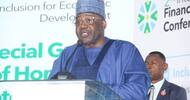
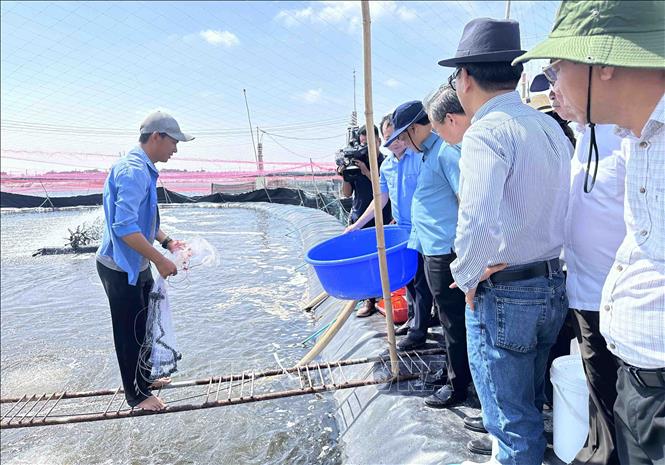
 Minister of Agriculture and Environment Trinh Viet Hung visits the super-intensive shrimp farming area of Vietnam Clean Seafood Joint Stock Company (Tran De commune, Can Tho city).Vietnam.vn | 9 May 2026
Shrimp businesses are requesting a relaxation of land use limits to facilitate large-scale production investments.
by Báo Tin Tức
On the morning of May 9th, a delegation from the Ministry of Agriculture and Environment, led by Minister Trinh Viet Hung, conducted a field survey and held a working session at the industrial shrimp farming area in Tran De commune, Can Tho city.
The purpose of the trip was to assess the current state of production, identify difficulties and obstacles related to policies and technical infrastructure, in order to promptly address them and create momentum for the development of Vietnam's key export-oriented seafood industry.
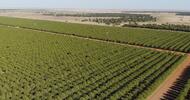
Reporting to the delegation, Mr. Vo Van Phuc, General Director of Vietnam Clean Seafood Joint Stock Company, stated that the company is currently operating a super-intensive shrimp farming model on a scale of 280 hectares, equivalent to 2.8 million square meters. According to Mr. Phuc, with the current investment level, the export value generated by this model reaches approximately 3 billion VND/hectare per year, 50 times higher than traditional agriculture. However, Mr. Phuc clarified that this is the actual export revenue, while profit accounts for at least 20% of the company's total annual revenue of 100-120 million USD. To achieve this economic efficiency, the investment per hectare is also very large, ranging from 2-3 billion VND/hectare.
Business representatives emphasized that the super-intensive shrimp farming industry not only brings in significant foreign exchange but also generates profits for the entire supply chain and provides employment for a large number of local workers. The farming areas of major companies in Vietnam have now achieved the highest international certifications for environmental and social welfare, fully meeting the stringent requirements to enter high-priced retail systems in developed markets such as the US, Japan, and the EU.
Despite achieving impressive results, Mr. Vo Van Phuc frankly pointed out a number of "bottlenecks" hindering the development of the shrimp industry. Regarding land policy, businesses currently face significant difficulties due to regulations prohibiting them from owning agricultural land and requiring them to purchase it through individuals. In this 280-hectare project area, the business has to rely on dozens of individuals to register over one hundred land titles, as current law only allows a maximum of 30 hectares of agricultural land per person. This creates significant legal risks and prevents the business from mortgaging its land use rights to borrow capital from banks, as leased land is not considered collateral.
Regarding credit policies, a representative from Vietnam Clean Seafood Joint Stock Company stated that agricultural businesses currently have almost no access to preferential capital. Banks are often hesitant due to risks in the agricultural sector caused by natural disasters, diseases, and the previous bad debt situation of small-scale farmers. Furthermore, the tightening of credit limits and cumbersome procedures are making it difficult for businesses to raise capital to purchase raw materials for export.
Regarding infrastructure and the environment, businesses recommend a comprehensive investment in transportation. Currently, access roads to production areas still include bridges with low load capacities of only 8 tons, hindering the transportation of heavy equipment and reducing logistics costs. Concerning wastewater standards, Mr. Phuc proposed considering the application of Column B instead of Column A for production areas near the coast not intended for domestic use, aiming to reduce treatment costs while still ensuring compliance with international technical standards.
After listening to reports and conducting on-site surveys in the shrimp farming area, Minister Trinh Viet Hung acknowledged the efforts of businesses in applying high technology and maintaining export markets. The Minister affirmed that the concerns about "constraints" in land and credit policies were entirely valid and that the Ministry had taken concrete steps to address them.
Minister Trinh Viet Hung stated that the upcoming revised Land Law will allow unlimited land consolidation and will not restrict the subjects involved, creating optimal conditions for businesses with sufficient resources to apply technology to large-scale production. Once the law is passed and implemented, businesses will be granted land ownership rights, thereby resolving the issue of collateral for accessing credit. According to the roadmap, the draft law will be submitted to the Government in June, reported to the Politburo in July, and is expected to be passed by the National Assembly in the October session this year to provide timely support to people and businesses.
Regarding credit issues, the Minister requested that subordinate units compile opinions and submit documents to the Ministry to provide a basis for working with the banking system to ensure the proper implementation of preferential packages for the agricultural sector. The Minister emphasized that if businesses can demonstrate stable output through long-term contracts, banks need to have mechanisms in place to provide capital support. At the same time, the Minister also noted that localities need to carefully study transportation planning and river port infrastructure to reduce operating costs for this specific production area.
Regarding environmental standards, the Minister affirmed the stance of not lowering standards to compromise exports, but emphasized the need for adjustments to align with production practices and global standards. Maintaining Category A is necessary for drinking water sources, but for the specific saltwater shrimp farming areas, clear distinctions are needed to avoid hindering businesses while still meeting the technical barriers of demanding markets. The Minister instructed relevant agencies to review and revise environmental standards for specialized production models such as super-intensive shrimp farming.
At the end of the working session, Minister Trinh Viet Hung highly appreciated the economic model in Tran De commune and affirmed that it is a model that needs to be replicated. The Minister encouraged businesses to continue proactively researching other potential markets such as Ecuador to learn from their experience in managing large-scale farming, thereby further increasing the export value of Vietnam's shrimp industry.