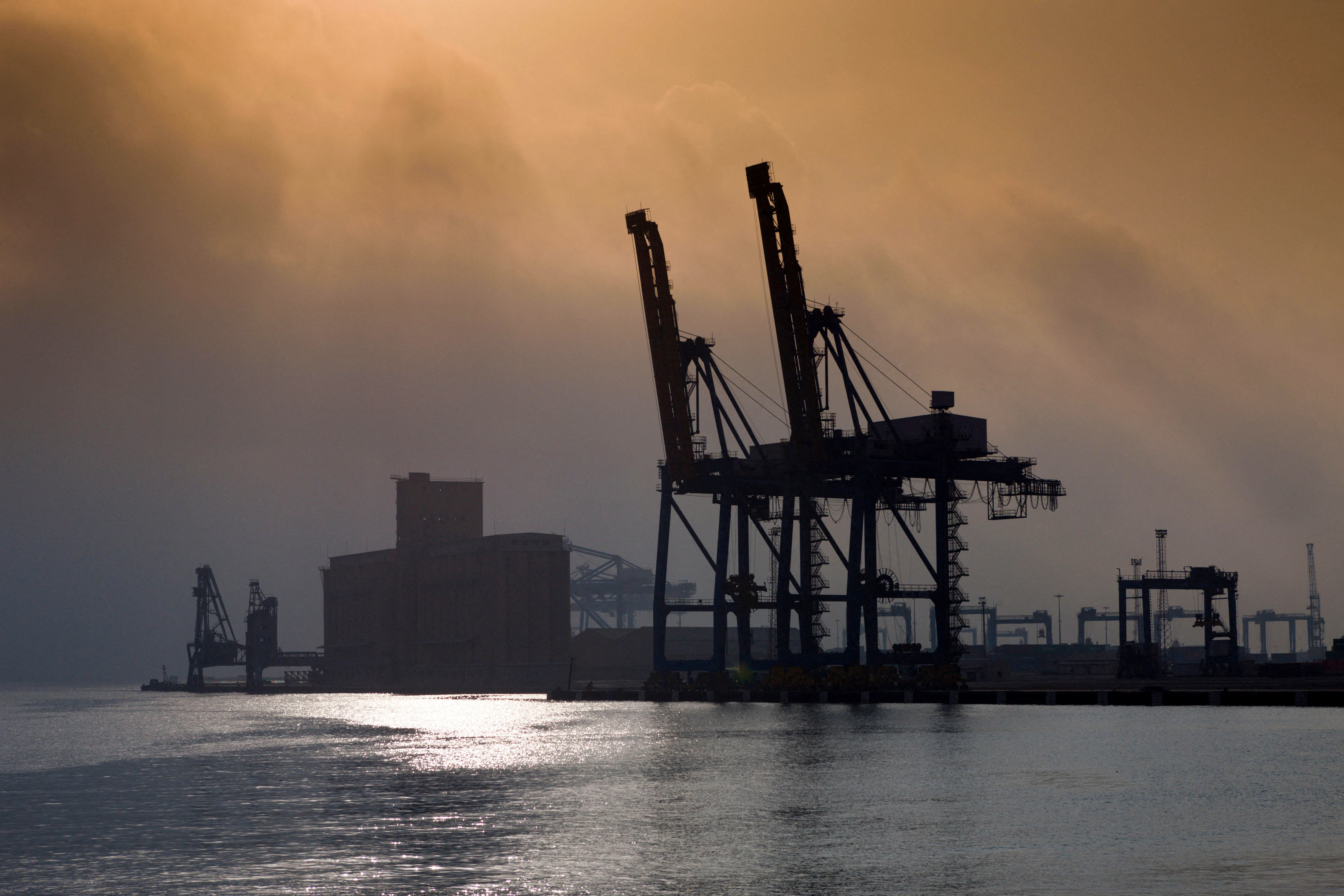
 Cranes tower over the harbour of Port Sudan, situated on the coveted Red Sea. Dockworkers here have repeatedly thrwarted UAE attempts to buy up the port. REINHARD DIRSCHERL/ALAMYJEHAD ALSHRAFI/ ASSOCIATED PRESS
The New Internationalist | 27 March 2026
The UAE's quiet empire
Eiad Husham
Eiad Husham traces the UAE’s long game for access to the Red Sea – a strategy built through ports, airports and infrastructure projects, and driven by ambitions to secure maritime power and regional influence.
At dawn in Port Sudan, dockworkers gathered at the gates of the country’s main maritime lifeline and refused to move. Towering cranes stood unmanned and cargo ships waited offshore along the eastern red-rust coastline. For three days the country’s busiest port – which straddles the land and the coveted Red Sea – was brought to a standstill.
The strike, which took place in early 2019, was observed by 1,800 workers taking a stand against a 20-year concession to hand over control of the South Port Container Terminal to a foreign operator widely believed to be acting as a front for Emirati capital. The contract gave International Container Terminal Services (ICTSI), a Philippine port operator, the right to develop the port, effectively privatizing the country’s main maritime artery. ‘They wanted to fire 80 per cent of the workers,’ one union organizer recalled bitterly, ‘and replace them with foreigners at cheaper rates’. This would have spelled disaster not only for the dockworkers but for the whole city. ‘This is our lifeline,’ one worker said. ‘Every family in the city depends on it.’
The deal was eventually suspended after public outrage, a victory for Port Sudan’s workforce. But it was only the beginning. In the years that followed, a clear pattern emerged. Control of the port was repeatedly pursued through different companies, often subsidiaries or ‘partners’ linked to Emirati logistics firms. Each attempt was framed as a commercial development deal, quietly advanced, then abandoned after worker resistance or political pushback. Despite these failures, the United Arab Emirates (UAE) focus never wavered, with renewed efforts resurfacing under new names.
The failed 2019 port deal was the first clear sign of underhand Emirati influence in Sudan, a hand that has continued to stretch across the country and the wider region, exploiting conflict and political fragmentation to advance a long-term ambition: dominance over the Red Sea. For centuries, this sea inlet has been one of the world’s most coveted waterways. Nestled between Africa and the Arabian Peninsula, it connects the Suez Canal to the Indian Ocean and beyond. Today, almost 10 per cent of the goods that reach Europe pass through its narrow straits. Whoever controls these docks doesn’t simply oversee shipping lanes but dictates the rhythms of international trade. In the race for control of the Red Sea, the UAE has emerged as a maritime empire – modern, discreet and deeply entangled in the region’s fractures.
Crisis as currency
Sudan’s war, which erupted in April 2023, has created the conditions for the UAE to advance its ambitions along the Red Sea. Yet the conflict did not mark the beginning of this project. Rather, it has exposed a long-standing strategy aimed at securing control over infrastructure, land, ports and natural resources across the Horn of Africa – an effort the Gulf state had been quietly pursuing for years.
While other powers seek stability, Abu Dhabi has learned to make instability profitable. Each conflict zone – a port left idle in Yemen, a state barely functioning in the Horn of Africa – presents opportunity. In its foreign policy, crisis has become currency.
‘This is a textbook case of modern geoeconomics: using investment, militias and maritime infrastructure to extract strategic value, even if the host country collapses socially and economically in the process,’ said Dr Wael Fahmi, an economist specializing in resource sector analysis.
In recent years the UAE has invested $60 billion in ports, airfields and logistical hubs up and down the coasts of Africa and the Arabian Peninsula, building an archipelago of influence that ties geography directly to strategic ambition. Control of infrastructure, not territory, forms the foundation of this empire.
Ports such as Berbera in Somaliland and Assab in Eritrea illustrate how instability has translated into negotiating leverage for the UAE. In 2016 DP World, the UAE’s state-owned seaport operator, signed a 30-year concession with Somaliland authorities to develop and manage Berbera port, later expanded to include a free zone and corridor projects. The deal was promoted using the language of development – investment, jobs and regional trade – at a moment when Somaliland faced diplomatic isolation and economic constraints, limiting its bargaining power.
A similar dynamic unfolded earlier in Assab, Eritrea, a country long isolated internationally for its dismal human rights record. In 2015, the UAE reached an agreement to rehabilitate and use the port and nearby airbase. Within months, Assab had been converted into a key Emirati military and logistics hub for operations in Yemen, where the UAE had been part of a Saudi-led coalition fighting the Houthi movement.
In both cases, crises worked to the UAE’s advantage, enabling it to trade mediation, investment and promises of stability for long-term control over the countries’ coveted positions on the Red Sea.
Unlike Saudi Arabia, which views instability in the region as a threat to be managed, the UAE views it as soil for growth. This distinction defines the two rivals: Riyadh’s vision hinges on transformation at home on its own stretch of Red Sea coast, touted as a new luxury destination for foreign travelers. Abu Dhabi by contrast advances its power in broken political environments – presenting itself as a ‘peace broker’ and the only source of ‘stability’ for struggling nations, allowing it to shape outcomes on its own terms.
‘It’s a mix of everything,’ said Sudanese analyst Dallia Abdelmoniem, summarizing the logic behind the UAE’s foreign policy. ‘Guaranteeing and securing their geopolitical status and influence, [gaining] access to resources they lack, be it economic or agricultural, and spreading and increasing their sphere of influences on the African continent, the Horn and the Red Sea. At the end of the day every political manoeuvre by the UAE is predicated on what benefits them, regardless of the detrimental cost and impact on the region, the people.’
That cost is tangible: wars prolonged, workers displaced, local companies gutted by offshore contracts – all masked by the language of progress. The UAE’s Red Sea vision is not philanthropy or benevolence. It is, Abdelmoniem argues, imperial self-interest dressed in modern branding.
Across the region, that strategy has taken shape through dual-use investments – civilian ports with military potential, ‘aid’ projects that double as foreign policy levers. DP World and Abu Dhabi Ports Group are not just commercial operators – they serve as instruments of influence, using investment and port management to extend strategic control. Eritrea's Assab port, and Berbera, where DP World holds a 51 per cent stake after making a $442 million investment, are key examples of this strategy.
‘Look at the map of Africa and pinpoint where the UAE has “invested” a huge stake,’ suggested Abdelmoniem. ‘By having control of the Red Sea area, be it Port Sudan, Somaliland, Djibouti, they control one of the world’s largest trade routes while weakening the original stakeholders who’ll be indebted to the UAE. The policy of the UAE is neocolonialism under the guise of economic and security growth.’
The same pattern extends to the east. In the El Fashaga triangle – a fertile, disputed stretch between Sudan and Ethiopia – the UAE offered to mediate between the two nations and invest simultaneously. The proposal envisioned that Sudan and the UAE would share 80 per cent of profits from large-scale agricultural projects, leaving 20 per cent for Ethiopian farmers. But this formula masked the reality: Sudan would surrender control over border land in exchange for speculative capital.
The UAE’s push into large-scale agricultural projects is not just about commercial expansion – it directly addresses the country’s pressing food security vulnerabilities. By securing farmland and agribusiness operations abroad, the UAE aims to guarantee steady supplies of essential crops and reduce reliance on global markets, which can be volatile. In doing so, these investments serve a dual purpose: they strengthen domestic food resilience while embedding Emirati influence in key regional economies.
In this new imperial geography, the Emirates have built a hub-and-spoke system of influence. Dubai sits at the centre, connected to a constellation of African ports, Gulf airfields and strategic routes for moving goods. Cargo, capital and political power circulate through these nodes.
This model thrives precisely where others falter. Fragile states, sanctioned regimes and conflict are not deterrents – they are the very conditions that allow Abu Dhabi to negotiate on its own terms. Chaos dilutes accountability. It allows deals to be struck in grey zones – between public and private, civil and military, legal and extralegal.
Empires once marched with flags; today they negotiate contracts. Where the colonial charter was once written by gunboats, it is now drafted by port authorities and venture capital
The geopolitical chessboard
Among those grey zones, Sudan stands as the Emirates’ most ambitious project and cautionary tale. On the map, Sudan is strategic: stretching from the Sahel to the Red Sea, linking sub-Saharan Africa to the Gulf. In reality, it is also fragile: decades of dictatorship, revolution and war have hollowed its institutions. For outside powers like the UAE, that combination of geography and fragility is irresistible.
‘The UAE’s interests in Sudan are much more about their broader geopolitical strategic interests than merely about their economic interests… around gold, agriculture,’ explains Sudanese researcher Hamid Khalafallah.
To Abu Dhabi, Sudan represents a pivot point – a country whose coastline secures access to a vital global trade route, whose earth bears vast reserves of gold and whose disunity can be easily exploited. Since the start of the war, the UAE has allied with the Rapid Support Forces (RSF), a militia fighting the Sudanese army for control of the country, and which has been accused of committing war crimes, ethnic cleansing and genocide.
Khalafallah explained that to understand Emirati behaviour, one must see their Sudan policy as part of a large arc stretching from Libya to Somalia. The UAE consistently backs non-state actors in regional conflicts, who in return can guarantee specific outcomes – security for a mine, control of a broader area, access to a port – without the friction of democracy.
‘Abu Dhabi does not care about Sudan’s political stability or state institutions,’ Khalafallah emphasized. ‘They prefer working with non-state actors, paramilitaries, militias like the RSF… they are much better served by weak institutions and less politically stable states, because that gives them more control.’
At the beginning of April 2024, a year into Sudan’s ongoing war, reports began to emerge that Abu Dhabi was also supplying the RSF with weapons and military support, giving a militia group with half the personnel of the Sudanese army a decisive advantage. While the UAE has repeatedly denied these allegations, evidence continues to mount. Beyond the politics lies an economic calculus: the RSF controls key supply lines for Sudanese gold, a resource that has been flowing into Dubai’s huge gold markets throughout the war.
By supporting the RSF, the UAE has prolonged the conflict, Abdelmoniem argues. ‘If they sought stability, we wouldn’t be in this devastating war for three years now. They want to extend their sphere of influence so they can have a say and dictate the political, economic and social makeup and set up in Sudan. If that means aligning with the likes of the RSF, so be it.’
The Emirates’ geopolitical calculus deepens when viewed against Saudi Arabia’s competing ambitions. On the opposite shore of the Red Sea, crown prince Mohammed bin Salman’s mega-project Neom seeks to turn northwestern Saudi Arabia into a futuristic economic hub with its own desert metropolis, a direct challenge to Dubai’s dominance in the region. The Emiratis’ push into Sudan is partly defensive – an effort to maintain parity by creating their own network of dependencies along Africa’s coast.
‘By having control over Sudan,’ Khalafallah said, ‘they position themselves in a much stronger spot to compete with Saudi Arabia.’
This competition merges economic pragmatism with paranoia. If Riyadh builds the cities of tomorrow, Abu Dhabi responds by acquiring the arteries of today’s trade. Sudan’s coastline, in this logic, becomes a chessboard of leverage – a place from which to rival Jeddah and control access to Africa’s markets.
But the UAE’s strategy also reshapes Sudan’s internal political economy. By securing privileged deals with RSF senior commanders, it reinforces patterns of corruption and exclusion. Investment flows not to democratic governance nor public infrastructure but to private fortunes tied to power brokers. The same dynamic that empowered the RSF also undercut Sudan’s fragile civilian movements. Foreign capital and domestic militarization feed upon each other.
The result is a paradox: a state too weak to resist exploitation, yet too strategically positioned to ignore. Sudan becomes both prize and pawn in a game larger than itself.
Strikes, ships and sovereignty
It wasn’t long after the 2019 port deal collapsed that the Emiratis made their next move for control of Port Sudan.
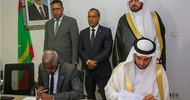
After the 2021 military coup on Sudan’s civilian-led government, the de facto administration that followed signed an initial $6 billion agreement with a consortium led by Abu Dhabi’s AD Ports Group and Dubai-based Invictus Investment. The agreement, signed in December 2022, was to build and operate a massive new dry port on the Red Sea coast known as Abu Amama, encompassing port facilities, an industrial zone, an airport and 400,000 acres of agricultural land.
But in November 2024, amidst the war, the military-backed government based in Port Sudan cancelled the planned port over the UAE’s alleged role in supporting the RSF. Finance minister Gibril Ibrahim declared at the time: ‘After what happened with the UAE, we will not give them a single centimetre of Sudanese land.’
Despite the cancellation, the symbolism remained. The Abu Amama deal exemplified what critics call Abu Dhabi’s ‘contract diplomacy’ – agreements signed with weakened governments that transfer control of key sectors to Emirati hands under the guise of modernization. In reality, these contracts shift economic sovereignty offshore. When investments sour, the corporations remain protected by international law; Sudanese workers, by contrast, face unemployment.
As one worker explained: ‘They talk about partnership and development, but every time the negotiations come, the workers lose.’
Control of infrastructure, not territory, forms the foundation of this empire
Since the war began three years ago, Sudan’s civilians have borne the brunt of violence, with at least 150,000 killed and many deaths unrecorded amid institutional collapse. The conflict has forced around 13 million people from their homes, including over 9 million internally displaced and more than 4 million refugees in neighbouring countries.
Despite the war, workers at Port Sudan continue to cling to daily life, keeping the port running under strain as a fragile lifeline for the country and a quiet act of resilience in the midst of conflict.
For residents of Port Sudan, the international contest for the seaport feels both distant and immediate. In cafés near the docks, talk revolves around wages and layoffs, not geopolitics. Yet every ‘memorandum of understanding’ signed in Dubai reverberates here – in cancelled shifts, new management rules, or slowdowns in cargo. ‘When they sign papers over there, our lives change here,’ said a middle-aged foreman who has worked at the port for 25 years.
The workers’ frustration reveals one of the many human costs of Emirati expansion. For Port Sudan’s labourers, modernization under foreign dominance means less autonomy, fewer benefits and vanishing bargaining power. ‘They call it progress,’ said one ship loader, ‘but it feels like we’re being erased.’
Yet amid these pressures, resistance persists. The dockworkers who fought the 2019 ICTSI deal set an important precedent: rejecting foreign encroachment even when the state endorsed it. Their protests – quietly organized, rarely reported – reflect a broader undercurrent of defiance that runs through Sudan’s working class. Such defiance aligns with an older history of anti-colonial labour movements that once resisted British and Egyptian authorities along the same coasts.
When the dockworkers in Port Sudan claim ‘This port is our lifeline’, their words echo across eras.
The Red Sea’s waters continue to shimmer under relentless sun, busy with tankers and cargo ships – symbols of global connectivity and inequality alike. Somewhere between progress and plunder, the UAE’s quiet empire sails on, its influence embedded not by conquest but by contract.