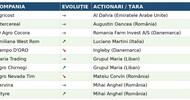
The UPA Government has deprived job opportunities to millions of illiterate and semi-literate Indians by forcing Indian companies to invest abroad in overseas plantations and coal mining sectors.
- Organiser
-
13 October 2009
Foreigners have an interest (partial or total ownership) in 1.6 percent of all privately held US agricultural land, a 1.4 million acre increase from 2007.
- Delta Farm Press
-
09 October 2009
A significant percentage of the manual labour force on arable land in Pakistan is female. If we lease this land to Saudi Arabia -- a country where women are not allowed to drive cars, vote, work in public places with a namehram -- to do with as it pleases -- will there still, across the proposed acreage reportedly twice the size of Hong Kong, be room for them?
Last May, while Pakistan’s military was waging its offensive in Swat, Islamabad officials were simultaneously launching another offensive in the Gulf: a charm offensive to secure investment in Pakistani farmland.
Tanzania has offered to lease land to Indian private companies for a period of 99 years, as it pitched for increased investment in the agricultural sector.
The terms of farmland deals are hardly made public. Although a theoretical possibility exists in a few cases for some transfer of technology for agricultural development, risk also exists to peasant farmers who cannot compete with well-resourced commercial farms. Take, for instance, the case of barley and oilseeds producers in Ethiopia.
- Abugida Info
-
13 August 2009
According to Steve Yuzpe, the CFO of Sprott Resource, ongoing population growth, dwindling arable land, water issues, even the falling yield productivity delivered by genetically modified seeds will be the big drivers for continued record demand—pushing food prices ever higher.
- Canadian Business
-
12 August 2009
It's a tsunami of land deals and, as all of the experts who have studied the phenomenon have agreed, no nation is truly prepared for its implications.
- CounterCurrents
-
17 June 2009
As world population expands, the demand for arable land should soar. At least that's what George Soros, Lord Rothschild, and other investors believe.
A recent jump in rich country land purchases in the developing world has caught the attention of analysts in trade and human rights circles.
- Bridges Weekly Trade News Digest
-
20 May 2009
The Caribbean is still struggling to develop a new agricultural model. While small scale agriculture and land ownership continues to have a deep rooted and emotional appeal, large scale farming with its echo of servitude–in the Anglophone Caribbean at least–remains far from attractive.
- Trinidad Express
-
02 May 2009
In 2006, Thailand had about 25 million farmers, who accounted for 40% of the population. The number is likely fall to 37% of the population by 2013. The government must act to reverse the trend, otherwise investors could rent or buy land from farmers to invest in large-scale farming, agricultural processing plants and hiring local people.
- Bangkok Post
-
22 April 2009
With Gulf countries and businesses demonstrating a newfound disposition for direct farm investment to cater for their local agro commodity needs, Sub-Saharan Africa has been identified as a source of growing and/or producing their imported food. Nigeria’s position in the matrix cannot be overemphasized.
“The food crisis in the spring of 2008 was a warning sign,” according to al-Obeid. Saudi Arabia is a net importer of agricultural products, especially rice, corn and soya. This fact is pushing the state to invest overseas. We’ve sent government and private-sector delegations to Turkey, Ukraine, Egypt, Sudan, Thailand, the Philippines, Vietnam, Ethiopia and Uzbekistan. These delegations have been very warmly received.”
- Le Monde Diplomatique
-
16 Mar 2009
AOAD Director-General Salim Allowzi said the private sector in the Arab World needs to step up investment in farming projects to cut the massive import bill, ensure enough farm products for the region and bolster food security.
- Emirates Business 24/7
-
04 February 2009
For the practical realisation of the goal of food sovereignty that has been eluding our nation since the time of independence, the importance of genuine agrarian reform and peasants’ rights cannot be underestimated.
- Daily times
-
20 January 2009
Land acquisitions abroad are the only viable response, Mohammed Raouf, program manager of environment research at the Gulf Research Center, and others say.
- The Christian Science Monitor
-
22 December 2008
Some experts believe that the emphasis should be on overseas agricultural investments as well as a boost in trade relationships, due to the unavoidable handicaps to domestic agriculture.
- The National
-
19 October 2008
Lured by soaring food prices, corporations - both domestic and foreign - have been snapping up land in this fertile region the size of France, replacing inefficient Soviet-style collective farming with modern farming techniques and economies of scale.
- Associated Press
-
19 September 2008
“Foreigners who come here get astonished at the gleaming black earth,” said Viktor Karnushin, head of a local subsidiary of Sweden’s Black Earth Farming corporation, one of the biggest foreign players in Russian farming.
- Associated Press
-
19 September 2008
GCC countries face growing constraints in agricultural capacity. Structural factors are exacerbating pressures on food prices. A new report from Standard Chartered supports additional investment in agriculture.
- Business Intelligence Middle East
-
09 September 2008
Three major multi-billion Shariah-based projects to boost infrastructure, agriculture and hospitality sectors in GCC and elsewhere in the Middle East, North Africa and South Asia were launched here yesterday.
- Gulf Times
-
28 August 2008
A food mega-project planned for a vast area in the Papuan district of Merauke is causing concern that indigenous people's land will be taken and their livelihoods destroyed.
- Down to Earth
-
01 August 2008
One issue reportedly delaying UAE investment in Pakistan is the Gulf state appearing to want “blanket exemption” from Islamabad’s agricultural export policies.
There is growing interest in agricultural land, which Bramdean Asset Management is looking at and believes has huge potential
- Global Pensions
-
11 July 2008
The Rivers State Government has reiterated its resolve to create an enabling environment to enhance rice production and processing, as well as promote and protect other agricultural business interests in the state.
- The Tide News
-
19 June 2008
The Government is considering the purchase of farmland worth US$500 million (Dh1.8 billion) in Pakistan as part of a strategy to lower food import costs.
- The National
-
08 June 2008
The Moroccan government has pursued a strategy of leasing state-farms previously under the management of Société de Développement Agricole (SODEA). A large number of bids were made by agricultural businesses from France, Egypt, Spain and the United Arab Emirates.
- Oxford Business Group
-
12 January 2008
A military-driven Chinese hybrid rice-for-opium crop-substitution program in the northern part of Myanmar's Shan state has resulted in four consecutive years of poor harvests and driven many ethnic-minority farmers into heavy debt or out of rice farming altogether.
- Asia Times
-
23 August 2007
In 2006, Beijing and Maputo signed a memorandum of understanding concerning the creation of a massive agricultural project in the Zambezi river valley area.
- ISN Security Watch
-
13 August 2007